Why Growing Trucking Businesses Run Out of Cash
Bolton Team
•

Why Growing Trucking Businesses Run Out of Cash (And What Actually Closes the Gap)
The story we hear most often isn't about a business that failed because the work dried up. It's about a business that grew. Good work, real relationships, more jobs every quarter, and a Thursday night spent deciding whether the supplier or the drivers get paid first.
That isn't a failure story. It's a cash flow story. And in bulk hauling, it's close to universal.

You grew the revenue. Where did the money go?
Growing fast in hauling means spending money before you make it.
Every new job needs trucks, fuel, and DEF up front. Drivers expect to be paid Friday. Material suppliers will extend you so much grace before they cut off access to the pit. Meanwhile, your biggest customers are sitting on Net 45, Net 60, or sometimes Net 90.
So the revenue line goes up, and the bank balance doesn't. You add a truck and your cash position gets worse, not better, because that truck runs for sixty days before anyone pays for what it hauled.
You're not bad at business. The timing is stacked against you, and it's stacked that way from the first job you ever booked.
The bad-margin job you can't afford to turn down
Here's the pattern underneath it.
You get quoted against a competitor hauling 80 miles round trip for a number you know doesn't work. Diesel costs what it costs. Wear and tear costs what it costs. Whoever quoted that either doesn't understand their own cost structure or is willing to bleed to win the job.
You know all that. And you still take the next thin job anyway, because suppliers are past Net 30 and payroll is Friday and the cash has to come from somewhere.
That's the trap. Not bad judgment, bad timing. The way out is getting paid faster on the good work you're already doing, so you're never so tight that you have to say yes to work that costs you money to run.
Why the bank says no
Plenty of operators try the bank route first. Real revenue, real growth, real business. And they hear some version of the same answer: high-risk industry, lumpy cash flows, not enough hard assets, not enough years in business, come back when the financials are cleaner. Then they come back with cleaner financials and hear it again.
It isn't personal. It's structural.
Trucking brokerages where you move material through owner-operators instead of owning the fleet outright don't fit the boxes traditional lenders underwrite. Banks want hard assets to backstop against. They want predictable cash flows they can model. They want two clean years from an industry that runs project to project, customer to customer, job to job.
And even when you clear every bar, a bank typically wants first UCC position, which conflicts with any factoring arrangement already in place.
Merchant cash advances will fill that void. They'll also take a daily payment out of an already-tight position, which usually makes the underlying problem worse rather than better.
What invoice funding does instead
Invoice funding isn't a loan, and it isn't a workaround. You already did the job. The ticket is signed. Instead of waiting 60 or 90 days for the GC, you get most of that money now, and the funding partner collects on the customer's normal schedule later.
Bolton funds up to 90% of the invoice. When your customer pays, you get the remaining reserve, minus the fee. No monthly payments. No debt on your books. You did the work. You earned the money. You're not borrowing; you're getting your own money faster.
If you want the mechanics start to finish, that's laid out on How It Works.
What a funding partner should do in the moments that matter
Funding is the product. Infrastructure is what keeps it standing under pressure.
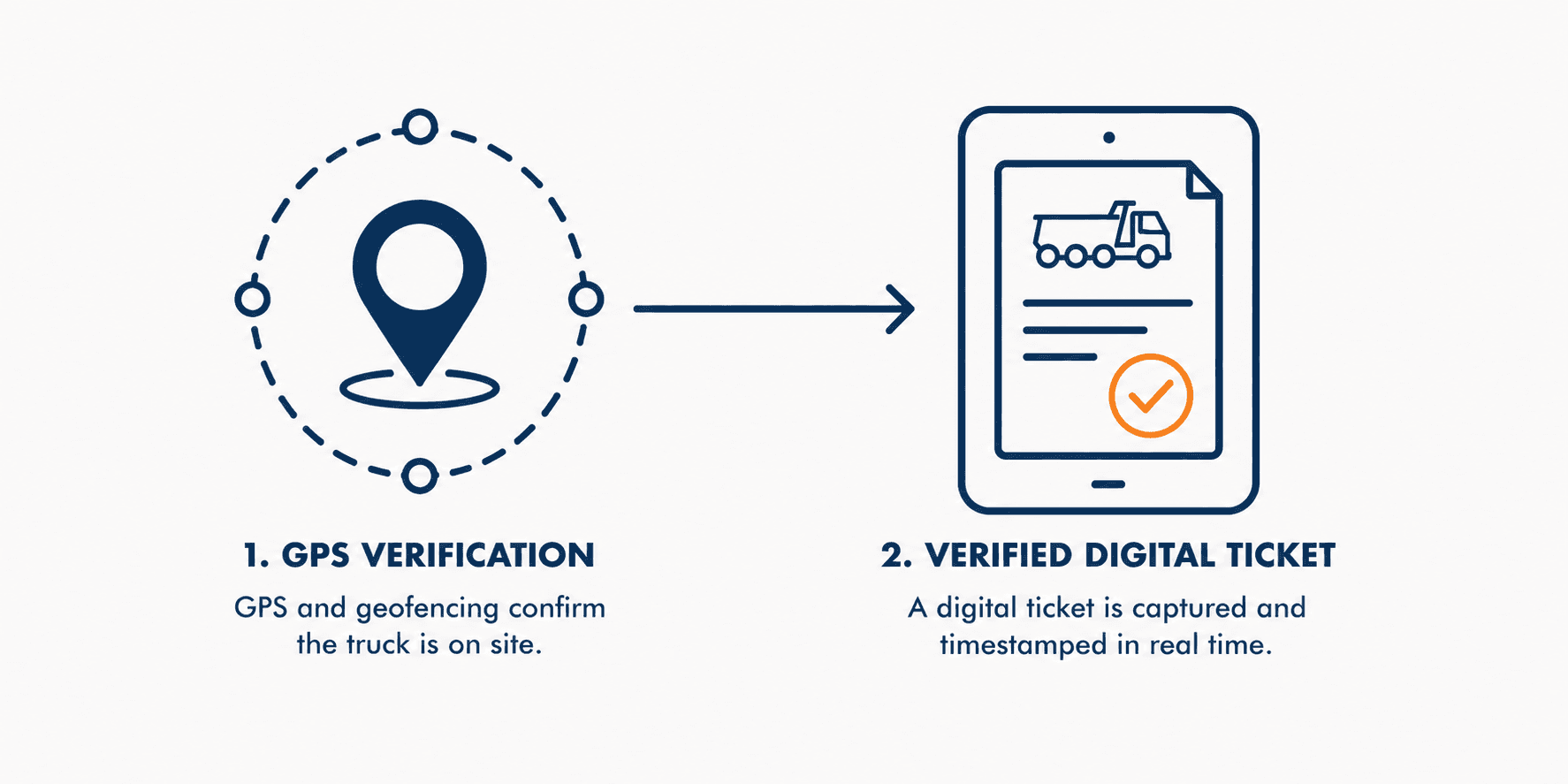
· Documentation that ends arguments. When a general contractor questions whether the trucks were on site or the material was delivered, geo-stamped digital tickets settle it with a record instead of a phone call. Through our integration with TruckIT, GPS timestamps, geofencing, and digital tickets are captured as the job runs. That's also why funding can happen in hours instead of days; the verification already exists before you submit.
· Invoicing the day the job runs. If paper tickets are still traveling from the truck to the office, you're billing a week in arrears, and every invoice starts its clock late. Digital ticketing lets you invoice same-day, as often as you want. No batching.
· Working the problem, not the penalty. If a customer mails a check to your office instead of remitting it correctly, the useful response is closing the gap in the process so it doesn't recur. Our interests are aligned there: we need your customers paying cleanly and your business running cleanly.
· Understanding the payment chain. In a lien situation where the GC hasn't been paid by the developer yet, a finance partner who actually understands construction payment sequencing is worth more than one who only understands invoices.
Faster collection changes more than your bank balance
Collection speed is the lever most operators never touch.
How long your invoices sit out is part of what your funding costs; a receivable at 120 days carries more risk than one at 40, and pricing reflects that. Your exact rate is set upfront in your term sheet, with no origination costs, termination penalties, or exit fees, and you can see it in a preliminary approval before committing to anything. Common questions on that live on the FAQ page.
The operational payoff compounds:
· Clean books mean you can see margin job by job. · Margin visibility means you know which work to take and which to walk away from. · Walking away from thin work means you stop subsidizing competitors who haven't done that math.
That's the difference between treading water and building something, and an operation with clean books, a documented pipeline, and a real margin profile is simply a stronger business to own.
The bottom line
If your revenue is growing and your cash position doesn't reflect it, the answer probably isn't a bank loan. It's getting paid the day you haul, tightening the systems that let you collect faster, and working with a partner whose incentives line up with yours.
Worried this changes your GC relationship? That's the most common question we get, and we answered it directly in Will This Get Between You and Your Customer.
Ready to see what same-day funding looks like for your operation? Apply Now. No commitment, no hard credit pull. We'll get back to you within 24 hours. Text or call (470)-305-0257 to learn more